Due to a lack of quorum, the Supreme Court of the United States declined to make a bright line rule as to whether U.S. copyright law will go global and eclipse foreign copyright laws.

This comes after the Fifth Circuit’s decision in Vetter v. Resnick, where the court held that termination rights (17 U.S.C. § 304) and the renewal provisions (1909 Copyright Act) give the copyright holder a single international master copyright under US Copyright Laws to recapture the work’s interest (in Vetter: copyright to a song) across international markets. Thus, conflicting with the long-standing international standard of the Berne Convention, that copyright is established and protected by local laws following the principle of territoriality.

Because the Supreme Court did not publish an opinion agreeing or disagreeing, authority on the issue reverts to the Fifth Circuit’s holding, where it is implied that each foreign territory may have to honor U.S. copyright law. Consequentially, authors and heirs in the states of Texas, Louisiana, and Mississippi could leverage this decision to terminate foreign copyright grants. Additionally, the holding could be very persuasive for other courts and different copyright matters.

This article will provide a brief review of the status quo and how the Vetter case may change the landscape for copyright holders and licensees.

Territoriality: How Copyright Protection Works Globally

Commercial exploitation of copyrightable works abroad is traditionally supported and protected by the principles of territoriality and national treatment under the Berne Convention. Territoriality provides that each sovereign nation may impose its own intellectual property laws within its borders. National treatment requires that each member nation give citizens of the sovereign member state the same protection that it gives its own citizens. All members to this convention, including the U.S. as of 1989, shall recognize copyrightable interests according to the laws of the foreign member state. For example, if a copyrightable U.S. work is infringed in France, the scope of protection and remedies of French law should govern. Or, if the heirs to a deceased artist’s song want sole control over the song’s exploitation in Mexico, the heirs must apply Mexican law and procedure to the termination interest.

Vetter: US Copyright Imposition and Hegemony

The Fifth Circuit had to decide whether termination rights under U.S. law applied beyond U.S. soil. Ultimately, it held that the Vetter Parties were the sole owners of the copyright to the song around the world. Plaintiffs were Cyril E. Vetter, one of the original song owners, and Vetter Communications Corporation, (the Vetter Parties) an entity represented by the heirs of the song’s deceased co-writer, Donald Smith. Respondents were Robert Resnick and the entity Resnick Music Group (the Resnick Parties). The Resnick Parties acquired a copyright interest in the song after purchasing the entity of Windsong Music Publishers, Inc. Vetter and Smith had assigned their rights to Windsong in 1963.

The issue for the Vetter Parties arose when ABC sought to broadcast and digitally stream the song “Double Shot (Of My Baby’s Love)” for a TV episode under a broad license from the Vetter Parties. The Resnick Parties were claiming 25% ownership of the song’s renewal rights. In response, the Vetter Parties wished to terminate the Resnick Parties’ rights by relying on 17 U.S.C. § 304(c) and its intent. Under this statute, authors or heirs can terminate copyright grants made prior to 1978 to protect themselves from unremunerative agreements that inhibited economic success. Resnick Parties countered the Vetter Parties’ use of the termination statute by arguing that pursuant to § 304(c)(6)(E), Vetter Parties remained an owner of the song’s copyright, but only domestically. Applying statutory interpretation, the Fifth Circuit agreed with the Vetter Parties and determined that the effects of termination under Title 17 and the U.S. Copyright Act Of 1976 apply to any U.S. copyright interest, regardless of geography.

The Fifth Circuit reasoned that the Berne Convention and its geographic presumption were not at all implicated by the termination statute because the original contractual transfer of the song required exclusive rights throughout the world. The court argues that in consideration of ownership of these global rights, the termination statute should allow the owner to completely recapture the song’s domestic and international rights. As a result, Vetter Parties gain complete control over the copyright asset and its economic viability.

Why Could This Matter and What Would Change Post-Vetter?

Since the Fifth Circuit Decision is upheld, for now, the implications could be manifold for authors, licensors and licensees.

Benefits for authors of U.S. copyrighted works could include:

  • The ability to recapture complete control over a creative asset, which in turn gives the holder sole access to the asset’s financial exploitation.
  • The increase of bargaining power for artists in negotiations; now, artists can leverage this holding to gain more favorable licensing terms with record companies and production companies seeking worldwide exploitation.
  • The increase in reliance on the Fifth Circuit precedent, enabling forum shopping for litigating artists who identify an asset to recapture globally.

Meanwhile, licensees and rights holders face a myriad of practical implications, as the global order of intellectual property practice confronts uncertainty. Implications include:

  • Previously, rights held abroad were perceived as secure under international agreements. Now, said rights are subject to termination and reversion by original authors and/or their heirs.
  • Due diligence should require further examination of the original grant, the source of each territorial right, in addition to authorship status and successor interests.
  • Companies that acquire rights to film, TV, publishing, adaptation, or music works should consider the increased risks to chain of title and ownership much more carefully, as there may be conflicting legal authority. For example, a UK court might acknowledge the request for reversion of the U.S. copyright, but which law it will apply to determine who owns the rights remains unclear.
  • Long-term agreements for licensees and publishers to exploit legacy catalogs are at risk of being terminated. In turn, business models that rely on the long-term benefits of these licenses are at risk of disruption at the loss of vital assets.
  • The potential for a worldwide recapture should be considered when licensees are determining the valuation of an asset. The likelihood of global recapture and the uncertainty of enforcement could diminish the asset's value.
  • Licensees should consider negotiating the forum or venue in the scenario a termination dispute ensues.

The consequences could be even more drastic based on the case's persuasiveness in other courts and circuits because the decision could be applied broadly, beyond termination rights or renewals. Specifically, arguments in cross-border infringement (17 U.S.C. § 502) cases could rely on the Fifth Circuit's rationale when establishing which remedy should apply. Attorneys could rely on the Fifth Circuit’s rationale, and its interpretation of the “arising under this title” for infringement claims, particularly when the infringement occurs in a foreign country.

Expectations Ahead

Ultimately, Vetter suggests that United States copyright law supersedes the principles of the Berne Convention by establishing an omnipresent authority over creative works made by human authors that are contractually offered for global distribution. As a result, foreign assignees can be stripped of their international rights to U.S. work. Additionally, the holding remains incredibly persuasive for other courts and copyright matters. The Vetter court would say this is a harmonious effect in tune with established law. Nonetheless, international and foreign interests remain at risk.

More than 8,000 game demos were showcased at Steam Next Fest in October, but some planned demos never made it.


For example, Alliance Arts canceled the public demo of “Drunken Goddess Reflux” just a few days before the event. That same week, Digital Sun, the studio behind “Moonlighter,” canceled a planned public playtest for “ReVamp” and opted instead for a closed Discord test. Both cited the same reason: the fear that someone might recreate the game using AI tools before its release.

The risk is real, as copycats are now feeding demos, trailers, and screenshots into AI tools and rebuilding a game's basic features, sometimes in as little as a day. However, skipping a demo has real drawbacks, as demos have long been one of the most effective ways to build wishlists before release, and events like Next Fest are an important way for indie games to draw attention to themselves.

There is a middle ground. By limiting what you show, who sees it, and how early, you can reduce the risk, and some low-cost legal steps taken before release can make it easier and more cost-effective to stop a clone.

Your mechanics are fair game. Your art is not.

Under U.S. copyright law, game ideas and mechanics are generally not protected. Anyone can develop a “match-three” game or a puzzle game with falling blocks, which is why the industry has always been full of games that look very similar.

What copyright law protects is the expression: code, art, music, characters, dialogue, and the audiovisual presentation. The line between an unprotected idea or game mechanic and a protected expression is not always clear. Courts consider the overall look and feel, and an infringement is generally found only where the copying is close.

This is important when it comes to AI clones. Most are created from scratch based on what is shown in the demo, trailers, and screenshots, so they rarely contain copied code. Your strongest claims arise when a clone copies your actual art, music, or other assets, or, less commonly, when a downloadable demo is decompiled and its code is reused.

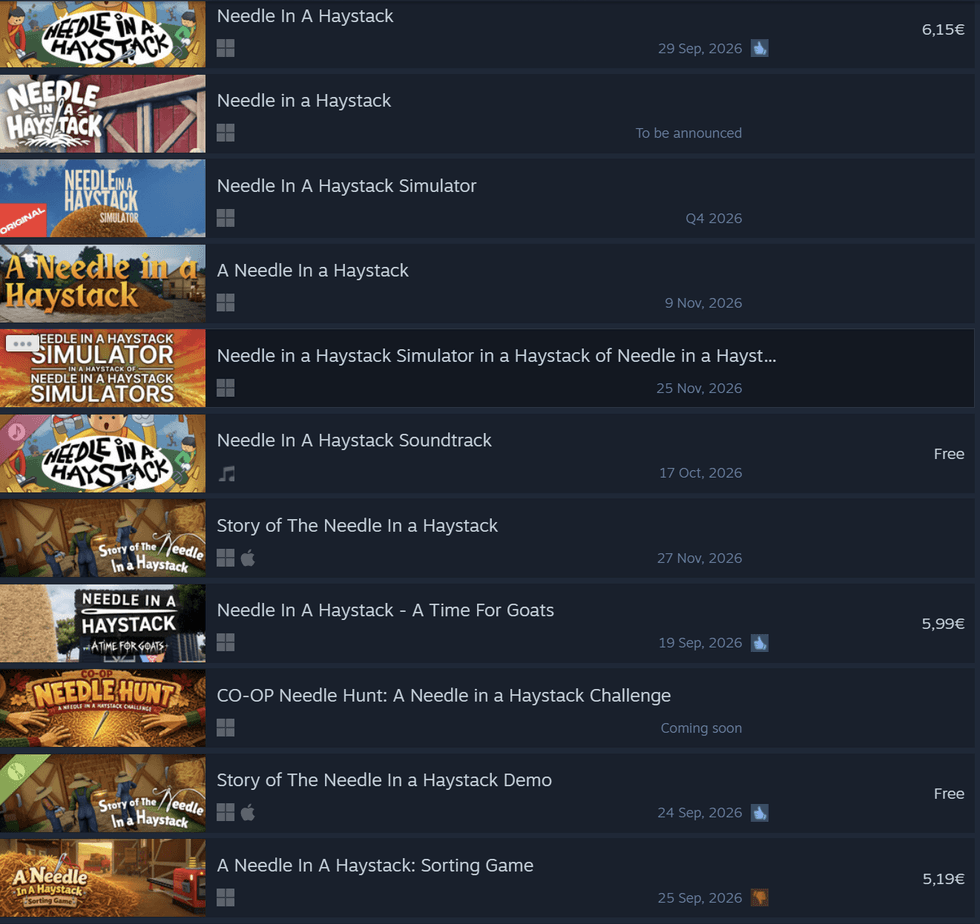
Then there is the name of your game. When “Needle in a Haystack Simulator” went viral, titles with similar names and store pages began appearing on Steam even before the game’s release. Here's what a Steam search for the title turned up in November 2026. Only one of these is the original, which is the one marked "Original":

Game titles and studio names can also be protected by trademark law, and a registered trademark puts you in a much stronger position to ask a platform like Steam to remove a game with a confusingly similar title. Earlier this year, the holder of a U.S. registration for "Hidden Cats" filed a trademark complaint with Valve, and other developers were told to retitle their games. That is why it is worth applying for a trademark early on.

Patents can protect a truly new game mechanic, but they are expensive, take years to obtain, and are often difficult to secure. If you plan to apply for a patent, you should file the application before the demo is released, as the release could be considered a disclosure that undermines your patent.

Knowing what is protected is only half the battle. To be able to respond quickly and cost-effectively when a clone appears, you need to prepare before the demo is released.

Five things to do before you hit publish

These measures typically cost only a fraction of what a lawsuit would cost and are affordable for most indie developers.

1. Decide what you show, who sees it, and when. A “vertical slice” or a curated playable trailer limits what can be copied. A closed playtest limits who receives the version and allows you to require everyone to accept your terms first. Timing is also important: Register your rights before the build goes public. However, even a smaller build is still a build. It can be decompiled and its art copied, so the following steps still apply.

2. Make sure you actually own your game. Freelance art designers, commissioned composers, and the friend who designed your user interface may still own their works unless those works have been assigned to you or licensed to you in writing. If they are the owners, you may not be able to enforce your rights. AI-generated assets raise a related issue: purely AI-generated output may not be protected by copyright. If your key art comes directly from an image generator, a copycat could potentially copy it without much risk. Keep records of the human creative work behind your key assets.

3. Register your work before you publish it. In the U.S., copyright arises automatically, but registration is crucial if you need to enforce it. You generally need to register before you can file a lawsuit, and registering before an infringement begins or shortly after publication can entitle you to statutory damages and attorneys’ fees. When fighting a rapidly emerging clone, this can make the difference between a credible threat and an empty one. Register the demo version, key art, and trailer before the demo is released. Also, file trademark applications for your game title and studio name before the announcement so you can take action against similar titles. Registration can take months; the sooner you file the application, the sooner you will have a registered trademark you can rely on.

4. Set specific terms for your demo. A demo EULA, as well as a non-disclosure agreement (NDA) or a playtest agreement for closed playtests, should prohibit reverse engineering, decompilation, redistribution, and the use of the version to train AI or recreate the game. For closed tests, rules regarding streaming can also be established. These terms are binding only on those who accept them; thus, they do not prevent someone from copying content from a YouTube video. However, they do give you a contractual claim against anyone who agreed to them and then violated them.

5. Have an enforcement plan ready. Know in advance who files the takedowns, what evidence you need and how fast you can move. Speed matters when a clone is collecting your wishlists.

Got cloned?

First, find out exactly what has been copied.

The answer will determine your options for taking action. If they copied your assets, code or branding, you have the clearest and most cost-effective options available: filing copyright and trademark takedown notices through the platform, as well as issuing cease-and-desist letters. This is where your registrations and trademark applications really pay off.

If only the “look and feel” has been copied, you can still submit a takedown request, but you should expect resistance. If the copier challenges this, a look-and-feel claim will usually end up in court. If a tester or player has violated your demo terms of use and can be identified, you may also have a breach-of-contract claim.

A lawsuit is a last resort and is most likely with look-and-feel claims. It is costly and time-consuming, may be impractical against a cloner based abroad, and carries a real risk, as the line between idea and expression is rarely clear-cut. For most indie developers, it only makes sense if the value of the game justifies it. However, the cost and risk cut both ways: the cloner faces them too, along with unwanted publicity. That gives you leverage, so it is usually worth sending a cease-and-desist letter first. Often, that is enough to get the clone taken down or reach a settlement.

The Checklist

Before your demo is released:

1. Scope: Determine what the version will include, who will receive it, and how long before launch it will be released.

2. Ownership: Signed assignment agreements or licenses for each asset.

3. Registrations: Copyright registrations for the demo build, key art and trailer.

4. Trademarks: Applications for your title and studio name.

5. Demo Terms: A demo EULA and a playtest confidentiality agreement tailored to the risks of the AI era.

6. Enforcement Plan: Takedowns and next steps, ready to go.

The studios that pulled their demos and playtests in October made a sensible call. Still, a demo remains one of the best tools you have. Be deliberate about what you show, who sees it and when, protect what you do show, and talk to a lawyer before it goes live.

Due to a lack of quorum, the Supreme Court of the United States declined to make a bright line rule as to whether U.S. copyright law will go global and eclipse foreign copyright laws.

This comes after the Fifth Circuit’s decision in Vetter v. Resnick, where the court held that termination rights (17 U.S.C. § 304) and the renewal provisions (1909 Copyright Act) give the copyright holder a single international master copyright under US Copyright Laws to recapture the work’s interest (in Vetter: copyright to a song) across international markets. Thus, conflicting with the long-standing international standard of the Berne Convention, that copyright is established and protected by local laws following the principle of territoriality.

Because the Supreme Court did not publish an opinion agreeing or disagreeing, authority on the issue reverts to the Fifth Circuit’s holding, where it is implied that each foreign territory may have to honor U.S. copyright law. Consequentially, authors and heirs in the states of Texas, Louisiana, and Mississippi could leverage this decision to terminate foreign copyright grants. Additionally, the holding could be very persuasive for other courts and different copyright matters.

This article will provide a brief review of the status quo and how the Vetter case may change the landscape for copyright holders and licensees.

Territoriality: How Copyright Protection Works Globally

Commercial exploitation of copyrightable works abroad is traditionally supported and protected by the principles of territoriality and national treatment under the Berne Convention. Territoriality provides that each sovereign nation may impose its own intellectual property laws within its borders. National treatment requires that each member nation give citizens of the sovereign member state the same protection that it gives its own citizens. All members to this convention, including the U.S. as of 1989, shall recognize copyrightable interests according to the laws of the foreign member state. For example, if a copyrightable U.S. work is infringed in France, the scope of protection and remedies of French law should govern. Or, if the heirs to a deceased artist’s song want sole control over the song’s exploitation in Mexico, the heirs must apply Mexican law and procedure to the termination interest.

Vetter: US Copyright Imposition and Hegemony

The Fifth Circuit had to decide whether termination rights under U.S. law applied beyond U.S. soil. Ultimately, it held that the Vetter Parties were the sole owners of the copyright to the song around the world. Plaintiffs were Cyril E. Vetter, one of the original song owners, and Vetter Communications Corporation, (the Vetter Parties) an entity represented by the heirs of the song’s deceased co-writer, Donald Smith. Respondents were Robert Resnick and the entity Resnick Music Group (the Resnick Parties). The Resnick Parties acquired a copyright interest in the song after purchasing the entity of Windsong Music Publishers, Inc. Vetter and Smith had assigned their rights to Windsong in 1963.

The issue for the Vetter Parties arose when ABC sought to broadcast and digitally stream the song “Double Shot (Of My Baby’s Love)” for a TV episode under a broad license from the Vetter Parties. The Resnick Parties were claiming 25% ownership of the song’s renewal rights. In response, the Vetter Parties wished to terminate the Resnick Parties’ rights by relying on 17 U.S.C. § 304(c) and its intent. Under this statute, authors or heirs can terminate copyright grants made prior to 1978 to protect themselves from unremunerative agreements that inhibited economic success. Resnick Parties countered the Vetter Parties’ use of the termination statute by arguing that pursuant to § 304(c)(6)(E), Vetter Parties remained an owner of the song’s copyright, but only domestically. Applying statutory interpretation, the Fifth Circuit agreed with the Vetter Parties and determined that the effects of termination under Title 17 and the U.S. Copyright Act Of 1976 apply to any U.S. copyright interest, regardless of geography.

The Fifth Circuit reasoned that the Berne Convention and its geographic presumption were not at all implicated by the termination statute because the original contractual transfer of the song required exclusive rights throughout the world. The court argues that in consideration of ownership of these global rights, the termination statute should allow the owner to completely recapture the song’s domestic and international rights. As a result, Vetter Parties gain complete control over the copyright asset and its economic viability.

Why Could This Matter and What Would Change Post-Vetter?

Since the Fifth Circuit Decision is upheld, for now, the implications could be manifold for authors, licensors and licensees.

Benefits for authors of U.S. copyrighted works could include:

  • The ability to recapture complete control over a creative asset, which in turn gives the holder sole access to the asset’s financial exploitation.
  • The increase of bargaining power for artists in negotiations; now, artists can leverage this holding to gain more favorable licensing terms with record companies and production companies seeking worldwide exploitation.
  • The increase in reliance on the Fifth Circuit precedent, enabling forum shopping for litigating artists who identify an asset to recapture globally.

Meanwhile, licensees and rights holders face a myriad of practical implications, as the global order of intellectual property practice confronts uncertainty. Implications include:

  • Previously, rights held abroad were perceived as secure under international agreements. Now, said rights are subject to termination and reversion by original authors and/or their heirs.
  • Due diligence should require further examination of the original grant, the source of each territorial right, in addition to authorship status and successor interests.
  • Companies that acquire rights to film, TV, publishing, adaptation, or music works should consider the increased risks to chain of title and ownership much more carefully, as there may be conflicting legal authority. For example, a UK court might acknowledge the request for reversion of the U.S. copyright, but which law it will apply to determine who owns the rights remains unclear.
  • Long-term agreements for licensees and publishers to exploit legacy catalogs are at risk of being terminated. In turn, business models that rely on the long-term benefits of these licenses are at risk of disruption at the loss of vital assets.
  • The potential for a worldwide recapture should be considered when licensees are determining the valuation of an asset. The likelihood of global recapture and the uncertainty of enforcement could diminish the asset's value.
  • Licensees should consider negotiating the forum or venue in the scenario a termination dispute ensues.

The consequences could be even more drastic based on the case's persuasiveness in other courts and circuits because the decision could be applied broadly, beyond termination rights or renewals. Specifically, arguments in cross-border infringement (17 U.S.C. § 502) cases could rely on the Fifth Circuit's rationale when establishing which remedy should apply. Attorneys could rely on the Fifth Circuit’s rationale, and its interpretation of the “arising under this title” for infringement claims, particularly when the infringement occurs in a foreign country.

Expectations Ahead

Ultimately, Vetter suggests that United States copyright law supersedes the principles of the Berne Convention by establishing an omnipresent authority over creative works made by human authors that are contractually offered for global distribution. As a result, foreign assignees can be stripped of their international rights to U.S. work. Additionally, the holding remains incredibly persuasive for other courts and copyright matters. The Vetter court would say this is a harmonious effect in tune with established law. Nonetheless, international and foreign interests remain at risk.

Subscribe to our newsletter

Latest Articles

Q1 2021 Tax Deadlines

2021 Estimated Tax – 2020 Tax Returns