

More than 8,000 game demos were showcased at Steam Next Fest in October, but some planned demos never made it.
For example, Alliance Arts canceled the public demo of “Drunken Goddess Reflux” just a few days before the event. That same week, Digital Sun, the studio behind “Moonlighter,” canceled a planned public playtest for “ReVamp” and opted instead for a closed Discord test. Both cited the same reason: the fear that someone might recreate the game using AI tools before its release.
The risk is real, as copycats are now feeding demos, trailers, and screenshots into AI tools and rebuilding a game's basic features, sometimes in as little as a day. However, skipping a demo has real drawbacks, as demos have long been one of the most effective ways to build wishlists before release, and events like Next Fest are an important way for indie games to draw attention to themselves.
There is a middle ground. By limiting what you show, who sees it, and how early, you can reduce the risk, and some low-cost legal steps taken before release can make it easier and more cost-effective to stop a clone.
Your mechanics are fair game. Your art is not.
Under U.S. copyright law, game ideas and mechanics are generally not protected. Anyone can develop a “match-three” game or a puzzle game with falling blocks, which is why the industry has always been full of games that look very similar.
What copyright law protects is the expression: code, art, music, characters, dialogue, and the audiovisual presentation. The line between an unprotected idea or game mechanic and a protected expression is not always clear. Courts consider the overall look and feel, and an infringement is generally found only where the copying is close.
This is important when it comes to AI clones. Most are created from scratch based on what is shown in the demo, trailers, and screenshots, so they rarely contain copied code. Your strongest claims arise when a clone copies your actual art, music, or other assets, or, less commonly, when a downloadable demo is decompiled and its code is reused.
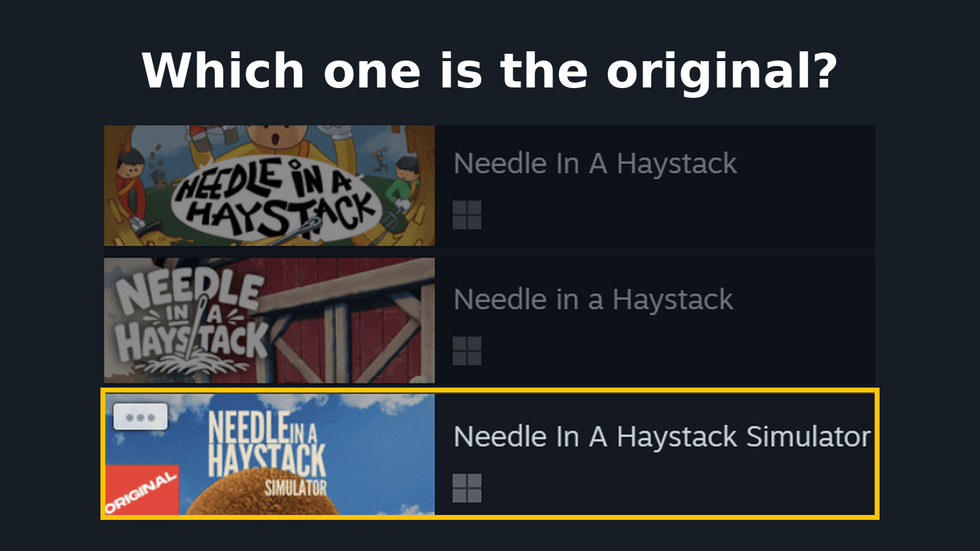
Then there is the name of your game. When “Needle in a Haystack Simulator” went viral, titles with similar names and store pages began appearing on Steam even before the game’s release. Here's what a Steam search for the title turned up in November 2026. Only one of these is the original, which is the one marked "Original":
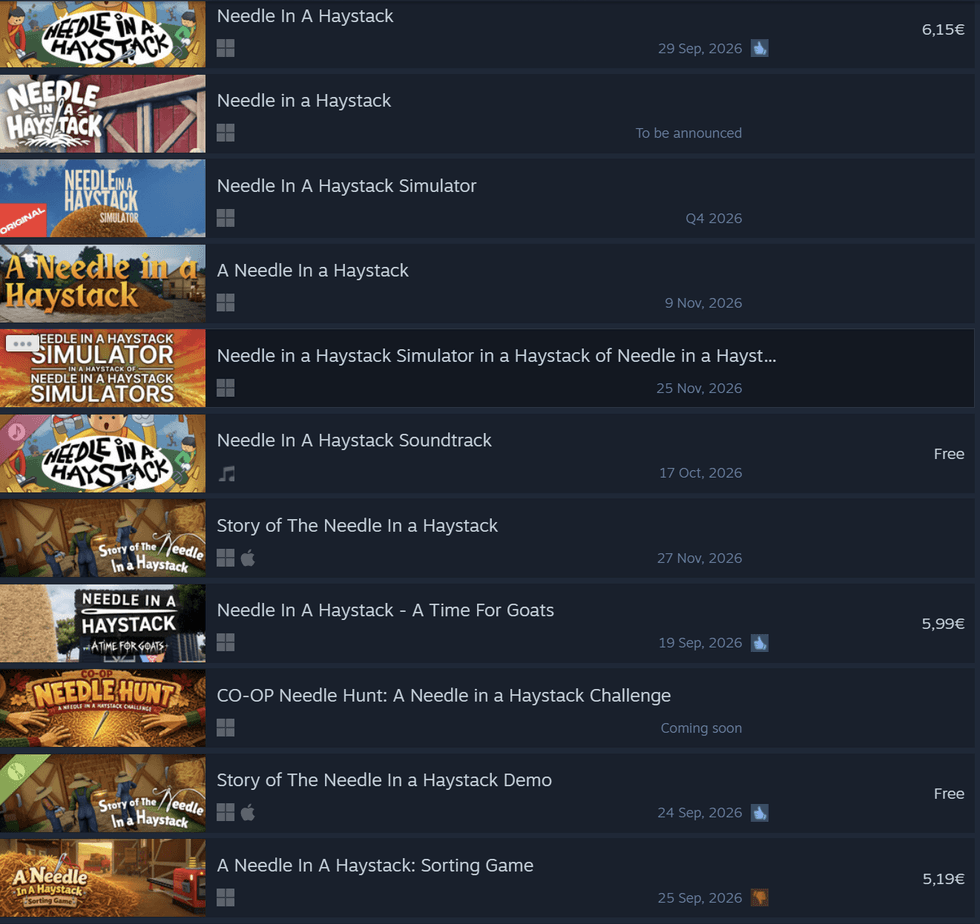
Game titles and studio names can also be protected by trademark law, and a registered trademark puts you in a much stronger position to ask a platform like Steam to remove a game with a confusingly similar title. Earlier this year, the holder of a U.S. registration for "Hidden Cats" filed a trademark complaint with Valve, and other developers were told to retitle their games. That is why it is worth applying for a trademark early on.
Patents can protect a truly new game mechanic, but they are expensive, take years to obtain, and are often difficult to secure. If you plan to apply for a patent, you should file the application before the demo is released, as the release could be considered a disclosure that undermines your patent.
Knowing what is protected is only half the battle. To be able to respond quickly and cost-effectively when a clone appears, you need to prepare before the demo is released.
Five things to do before you hit publish
These measures typically cost only a fraction of what a lawsuit would cost and are affordable for most indie developers.
1. Decide what you show, who sees it, and when. A “vertical slice” or a curated playable trailer limits what can be copied. A closed playtest limits who receives the version and allows you to require everyone to accept your terms first. Timing is also important: Register your rights before the build goes public. However, even a smaller build is still a build. It can be decompiled and its art copied, so the following steps still apply.
2. Make sure you actually own your game. Freelance art designers, commissioned composers, and the friend who designed your user interface may still own their works unless those works have been assigned to you or licensed to you in writing. If they are the owners, you may not be able to enforce your rights. AI-generated assets raise a related issue: purely AI-generated output may not be protected by copyright. If your key art comes directly from an image generator, a copycat could potentially copy it without much risk. Keep records of the human creative work behind your key assets.
3. Register your work before you publish it. In the U.S., copyright arises automatically, but registration is crucial if you need to enforce it. You generally need to register before you can file a lawsuit, and registering before an infringement begins or shortly after publication can entitle you to statutory damages and attorneys’ fees. When fighting a rapidly emerging clone, this can make the difference between a credible threat and an empty one. Register the demo version, key art, and trailer before the demo is released. Also, file trademark applications for your game title and studio name before the announcement so you can take action against similar titles. Registration can take months; the sooner you file the application, the sooner you will have a registered trademark you can rely on.
4. Set specific terms for your demo. A demo EULA, as well as a non-disclosure agreement (NDA) or a playtest agreement for closed playtests, should prohibit reverse engineering, decompilation, redistribution, and the use of the version to train AI or recreate the game. For closed tests, rules regarding streaming can also be established. These terms are binding only on those who accept them; thus, they do not prevent someone from copying content from a YouTube video. However, they do give you a contractual claim against anyone who agreed to them and then violated them.
5. Have an enforcement plan ready. Know in advance who files the takedowns, what evidence you need and how fast you can move. Speed matters when a clone is collecting your wishlists.
Got cloned?
First, find out exactly what has been copied.
The answer will determine your options for taking action. If they copied your assets, code or branding, you have the clearest and most cost-effective options available: filing copyright and trademark takedown notices through the platform, as well as issuing cease-and-desist letters. This is where your registrations and trademark applications really pay off.
If only the “look and feel” has been copied, you can still submit a takedown request, but you should expect resistance. If the copier challenges this, a look-and-feel claim will usually end up in court. If a tester or player has violated your demo terms of use and can be identified, you may also have a breach-of-contract claim.
A lawsuit is a last resort and is most likely with look-and-feel claims. It is costly and time-consuming, may be impractical against a cloner based abroad, and carries a real risk, as the line between idea and expression is rarely clear-cut. For most indie developers, it only makes sense if the value of the game justifies it. However, the cost and risk cut both ways: the cloner faces them too, along with unwanted publicity. That gives you leverage, so it is usually worth sending a cease-and-desist letter first. Often, that is enough to get the clone taken down or reach a settlement.
The Checklist
Before your demo is released:
1. Scope: Determine what the version will include, who will receive it, and how long before launch it will be released.
2. Ownership: Signed assignment agreements or licenses for each asset.
3. Registrations: Copyright registrations for the demo build, key art and trailer.
4. Trademarks: Applications for your title and studio name.
5. Demo Terms: A demo EULA and a playtest confidentiality agreement tailored to the risks of the AI era.
6. Enforcement Plan: Takedowns and next steps, ready to go.
The studios that pulled their demos and playtests in October made a sensible call. Still, a demo remains one of the best tools you have. Be deliberate about what you show, who sees it and when, protect what you do show, and talk to a lawyer before it goes live.